
Borrowing Against Mined Bitcoin Without Selling the Stack
A collateral loan turns coins you already hold into spendable cash, and the coins stay in your account while the debt is open. At 449 TH/s the pool pays about 0.00020142 BTC a day, roughly $17.06 at $84,692 per BTC, so the real question is not whether a position can be funded but whether it can be funded from mining output alone. This walkthrough covers the mechanics, the five steps, and the arithmetic to run before you pledge anything.

Key takeaways
- A pledge is comfortable when the daily net payout covers the repayment schedule: at 449 TH/s that is $16.38 a day after the listed 4% on the block-reward component.
- The flow is fixed and sequential: Add Collateral, Apply for Loan, Receive Loan, Repay Loan, Redeem Collateral.
- Collateral is valued at the BTC price of the day, so $84,692 per BTC is a snapshot rather than a promise.
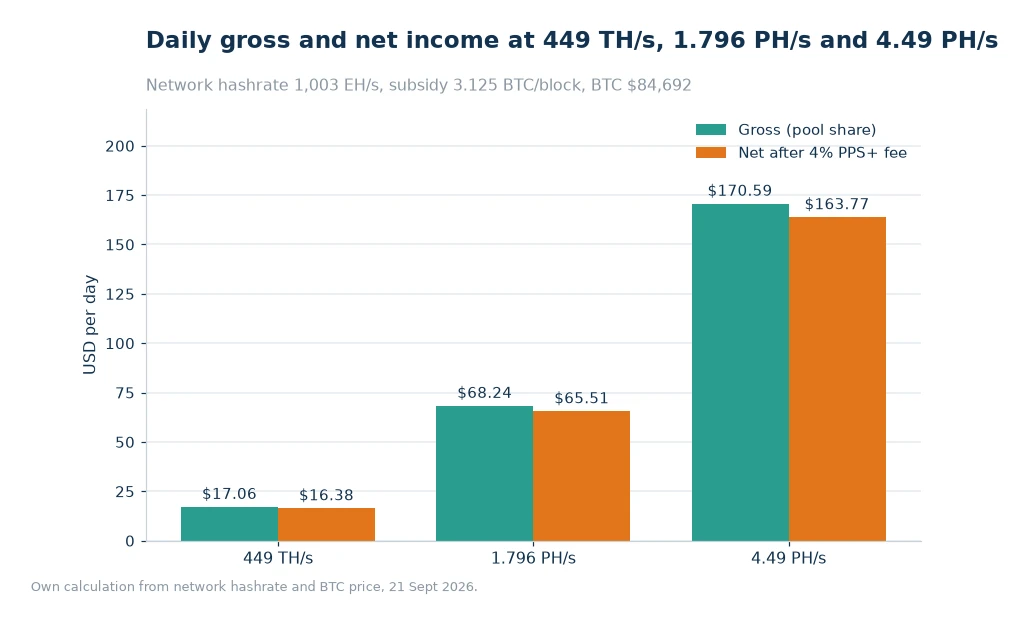
- Output scales in a straight line, so 4.49 PH/s grosses $170.59 a day against $17.06 at 449 TH/s, ten times the hashrate.
Why mined coins are awkward to hold
Mining pays in fractions. PPS+, the default method, settles every hour against current difficulty, while PPLNS settles once a block has 6 confirmations and shares the miner's slice across the last 5 difficulty rounds. Either way the balance grows in small steps, and small steps are hard to plan around when a power bill or a hardware invoice lands on a fixed date. Selling whatever has arrived by invoice day is the simplest answer and often the worst one, because it turns a price you did not choose into a sale you did not want.
Holding instead means paying that bill from somewhere else. A loan against the coins breaks the trade: the balance stays where it is, the invoice gets paid, and the debt sits against an asset you already own rather than against income you hope to receive. Nothing about borrowing raises the value of the coins. It moves spending power forward and leaves a repayment obligation behind, which is why the size of the daily payout matters more than the size of the collateral.
What Collateral-Pledged Loans actually do
The product is the ViaBTC Crypto Loan, and it runs as Collateral-Pledged Loans inside the same account that holds your mining balance. You lock a quantity of coins, draw a loan against them, and the coins stay pledged until the debt is cleared. Because the account is a multi-currency wallet, the pledged balance and the borrowed balance sit in one view instead of across two statements.
The useful way to size it is by collateral rather than by hashrate. The loan follows the value of the coins at the moment you apply, so a miner running 4.49 PH/s and a miner running 449 TH/s can pledge the same amount and see the same offer. Hashrate decides how quickly the pledged stack can be rebuilt after a repayment; it does not decide what the loan is worth.
The five steps in order
The sequence runs Add Collateral, then Apply for Loan, then Receive Loan, then Repay Loan, then Redeem Collateral. Each arrow is a separate action, not one approval that carries through to the end.
Add Collateral locks the coins and fixes the position. Apply for Loan is where the amount and terms are set against that collateral. Receive Loan moves the borrowed asset into your account, where it can be spent or moved on. Repay Loan clears the debt. Redeem Collateral is the final step and the only one that hands the coins back, which is why it belongs in the plan from day one rather than at the end of a stressful week. Skipping straight from Receive Loan to a spending decision is how miners end up with a position they never modelled.
Where hashrate meets the collateral
The payout is the one part of the position that changes every day without you doing anything. Convert it to dollars at $84,692 per BTC and the scale of the income side becomes easy to read.
| Hashrate | BTC per day | Gross USD per day | Net USD per day |
|---|---|---|---|
| 100 TH/s | 0.00004487 | $3.80 | $3.65 |
| 449 TH/s | 0.00020142 | $17.06 | $16.38 |
| 1.796 PH/s | 0.00080576 | $68.24 | $65.51 |
| 4.49 PH/s | 0.00201424 | $170.59 | $163.77 |
Nothing in that table depends on the loan. It is the income side only, and that is the point: a pledged position is serviced from these figures, not from the collateral itself. When the daily net number covers the repayment with margin, a fall in BTC price hurts the collateral before it touches the cash flow, and you get time to add collateral or repay early instead of reacting at the worst possible moment.
Worked example
Take 449 TH/s and follow the same formula the pool uses, with the network inputs read on 21 Sept 2026.
- Divide 449 TH/s by the network's 1,003,000,000 TH/s. The result is 0.0000004477, the share of total hashrate.
- Multiply by 450 BTC, the daily issuance from 3.125 BTC per block across 144 blocks. That gives 0.00020142 BTC a day.
- At $84,692 per BTC, the daily output is worth $17.06 gross.
- The listed 4% applies to the block-reward component: 4% of $17.06 is $0.68, which leaves $16.38 net.
- Scale to 4.49 PH/s, ten times the hashrate: 0.00201424 BTC and $170.59 gross, less $6.82, leaving $163.77 net.
- 1.796 PH/s sits between the two at four times 449 TH/s: 0.00080576 BTC, $68.24 gross and $65.51 net.
- Across 30 days the 4.49 PH/s position grosses $5,117.70 and nets $4,913.10. The $204.60 difference is the listed 4% on the block-reward side for that month.
Checking the position before you pledge
Two numbers decide whether a pledge feels routine or tense: the daily net payout and the collateral value at today's price. Push the first through the Profit Calculator using current difficulty, your listed rate and effective hashrate, then hold the result against the repayment schedule you were offered. A payout that covers the schedule with room left is a buffer. A payout that only just covers it means the next difficulty change decides the outcome for you.
For the second number, keep the estimate of a 2.12% difficulty drop at the next adjustment in view. Lower difficulty lifts daily output per unit of hashrate, which helps the income side and does nothing at all for the collateral. BTC price moves both sides at once, so a single price fall tightens the loan and shrinks the dollar value of the payout together. That is the scenario worth writing down before you sign anything, not after.
Frequently asked questions
How large a loan can I get against mined coins?
There is no single figure. The amount follows the value of the coins you pledge at the time you apply, so a position built at $84,692 per BTC is sized differently from one built at another price, and the terms shown at application are the ones that count.
Does pledging coins stop my mining payouts?
No. PPS+ keeps settling hourly against current difficulty and PPLNS keeps settling after 6 confirmations, while the pledged coins sit as a separate balance, so the mining income and the collateral move on their own tracks.
What happens after I repay the loan?
The debt closes at Repay Loan, and Redeem Collateral is the step that returns the pledged coins to your available balance, which is why it should be planned for at the start rather than discovered at the end.
Run the payout arithmetic first
Write three figures on one line: BTC per day at your hashrate, the net amount after the listed rate, and the monthly total in dollars. Set the monthly total beside the repayment schedule. If the payout is larger, mining funds the pledge and the five steps become routine administration. If it is smaller, the position leans on a price nobody controls, and every later decision about adding collateral gets made under pressure rather than on a quiet afternoon.
Sources: the ViaBTC loan page for the five-step flow and the pool fee schedule for the listed 4% on the block-reward component. Network hashrate 1,003 EH/s, difficulty 132.76 T, subsidy 3.125 BTC per block and BTC $84,692 were read 21 Sept 2026, published 22 Oct 2026[1]. Every dollar figure above is arithmetic on those inputs and moves when they move.