
A signature scent for a home fragrance line is a different brief from a signature scent for a perfume. The oil is only half of the project: what makes a scent recognisable on a shelf is how it loads into wax, how it climbs a reed, or how it flashes off a spray, and those are format decisions as much as olfactive ones. The scope should therefore name the formats first and the direction second, because the formats decide what the direction has to survive.
Key takeaways
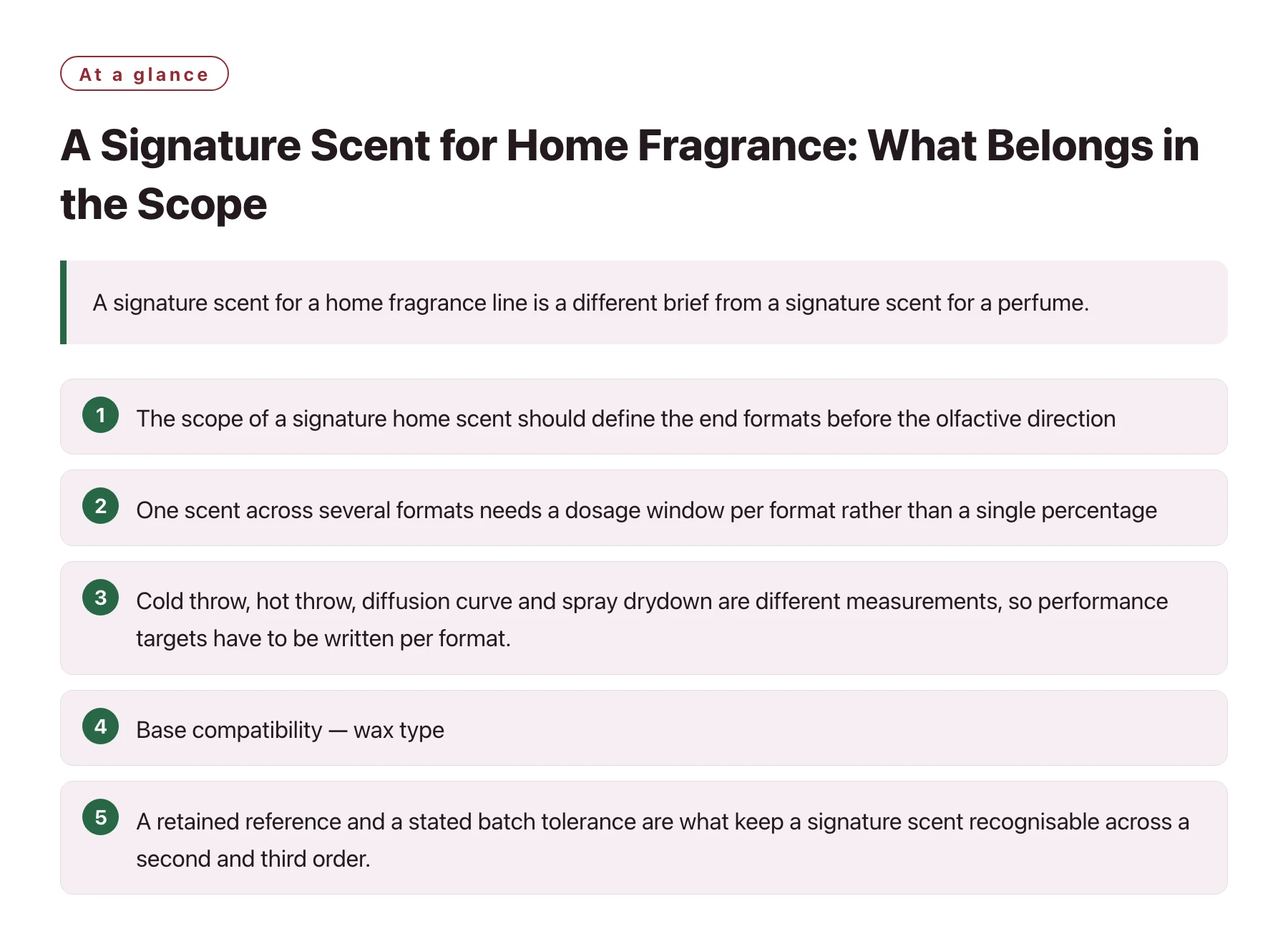
- The scope of a signature home scent should define the end formats before the olfactive direction, because dosage and performance are format-specific.
- One scent across several formats needs a dosage window per format rather than a single percentage, and separate approval for each.
- Cold throw, hot throw, diffusion curve and spray drydown are different measurements, so performance targets have to be written per format.
- Base compatibility — wax type, carrier, reed material, discolouration and viscosity — is a development question, not a production detail.
- A retained reference and a stated batch tolerance are what keep a signature scent recognisable across a second and third order.
House scents fail in two ways. They fail olfactively, which is obvious and usually fixable, or they fail technically, which is quieter: the candle smells wonderful in the lab and thin in the shop, the diffuser opens strong and dies in a fortnight, the spray is beautiful for a minute and then disappears.
The technical failure is a scope problem rather than a creative one, and it is easier to prevent than to correct. The checklist below is what a scope should contain when one scent has to hold together across several home formats.
What the scope should contain
- The end formats, namedCandle, reed diffuser, room spray, wax melt, sachet or linen product — decided before development, because each one changes the brief.
- A dosage window per formatA range rather than a single figure, with the upper end checked for cost and the lower end checked for performance.
- Performance targets in measurable termsCold and hot throw expectations for candles, duration and opening strength for diffusers, initial burst and drydown for sprays.
- Base compatibility requirementsWhich wax, which carrier, which reed material, and what the scent may not do — discolour, thicken, separate or stain.
- Wick, reed and hardware selectionThese are part of the scent system, not packaging afterthoughts; a wick mismatch can read as a fragrance failure.
- Testing on the finished formatStability, compatibility and discolouration checks run on the assembled product rather than on the concentrate alone.
- The reference and the toleranceA retained physical reference plus a written tolerance for colour, fill weight and performance so a reorder can be compared.
- How the scent will be describedOne olfactive description that works on a candle label, a diffuser carton and a product page without contradicting itself.
The same scent, three different jobs
| Format | What the scent must do | What to test for |
|---|---|---|
| Scented candle | Release evenly from the melt pool and carry across a room | Cold throw, hot throw, burn consistency and colour stability |
| Reed diffuser | Open with presence and then hold a steady level for weeks | Diffusion curve over time, evaporation rate and reed saturation |
| Room spray | Land immediately and leave a clean, non-cloying trace | Initial impact, drydown, residue on surfaces and nozzle performance |
| Wax melt | Perform without a flame and without a wick | Melt behaviour, throw at low temperature and packaging compatibility |
| Sachet or linen product | Stay present at ambient temperature for a long period | Longevity, transfer to fabric and packaging barrier performance |
The columns are the reason a single percentage cannot cover a range: the same oil can be too strong in one format and invisible in another, and the tests that prove performance are different in each case.
Where signature scents lose their signature
The most common failure is not a bad smell; it is drift. The candle that launched was approved at one dosage, the diffuser at another, and by the third order the wax supplier has changed and the throw has moved. Nothing has gone wrong in any single decision, and the range no longer smells like one brand.
Two habits prevent most of it. The first is to test the finished format rather than the oil, because compatibility problems between a fragrance and a wax or a carrier appear only in the assembled product. The second is to fix the reference and the tolerance in writing, so that a reorder is a comparison against a document rather than against a memory.
Compliance belongs in the same scope conversation. Fragrance materials are restricted by product category, and the standards library the industry works from sets limits that differ between a candle, a diffuser and a spray [1]. A scope that names the formats early also gives the supplier time to confirm the material statement each one needs, which is far easier before development than after it.
When the formats and the testing are held by one programme, the loop between a performance problem and a reformulation is short. That is the practical argument for working with a factory that handles fragrance R&D and production rather than splitting scent development from filling, and it is the same argument set out under R&D and manufacturing in one place. The commercial case is speed; the quality case is that the people who reformulate can see the finished format.
Finally, think about the exit as well as the entry. A signature scent that cannot be reordered by anyone else is a risk, not an asset, which is why buyers comparing a custom perfume manufacturer should ask what ownership model is on offer before the direction is finalised. The scent is the brand's most visible asset; the terms around it decide whether it stays that way.
A scope is complete when it can answer one question without further discussion: if the second order smells different from the first, what document decides whether it is acceptable? If nobody can name that document, the scope is still open.
Sources
- IFRA Standards Library (International Fragrance Association) —— The IFRA Standards Library lists the restrictions the fragrance industry applies to individual fragrance ingredients, based on safety assessments; it is the reference point for compliant fragrance formulation.
Frequently asked questions
Can one fragrance oil be used across a candle, a diffuser and a spray?
Usually yes, with different dosage and often with small modifications to the concentrate. The structure of the scent may also shift, because the notes that carry in wax are not always the ones that carry in alcohol.
How many sample rounds should a signature home scent take?
Budget for two to three rounds across all formats rather than per format. Most of the time goes into adapting the direction to each base, not into finding the direction itself.
Should the candle and diffuser share exactly the same formula?
Not necessarily. Sharing the olfactive idea matters more than sharing the exact concentrate, and forcing one formula across every format can compromise performance in all of them.
What makes a reorder smell different from the first order?
Common causes are a change of wax or carrier, a substitution in the fragrance concentrate, an unstated change in dosage, or the absence of a retained reference to compare against. The last one makes the others undetectable.
When should ownership of the scent be settled?
Before development begins, because it decides how the formula can be used, reordered and protected later. A developed scent and a library scent carry different ownership models, and both need to be written down.