
Mining Calculator Assumptions You Should Question
Every mining estimate is a stack of assumptions wearing a dollar sign, and five of them do most of the damage. At 800 TH/s the difference between 100% and 95% uptime is about $46.56 a month, an estimated +1.90% difficulty change costs roughly $17.40 a month, and a power price at the 20 J/TH breakeven of $0.0808/kWh erases a $931.20 month entirely. Audit those five inputs before you trust the total.

Key takeaways
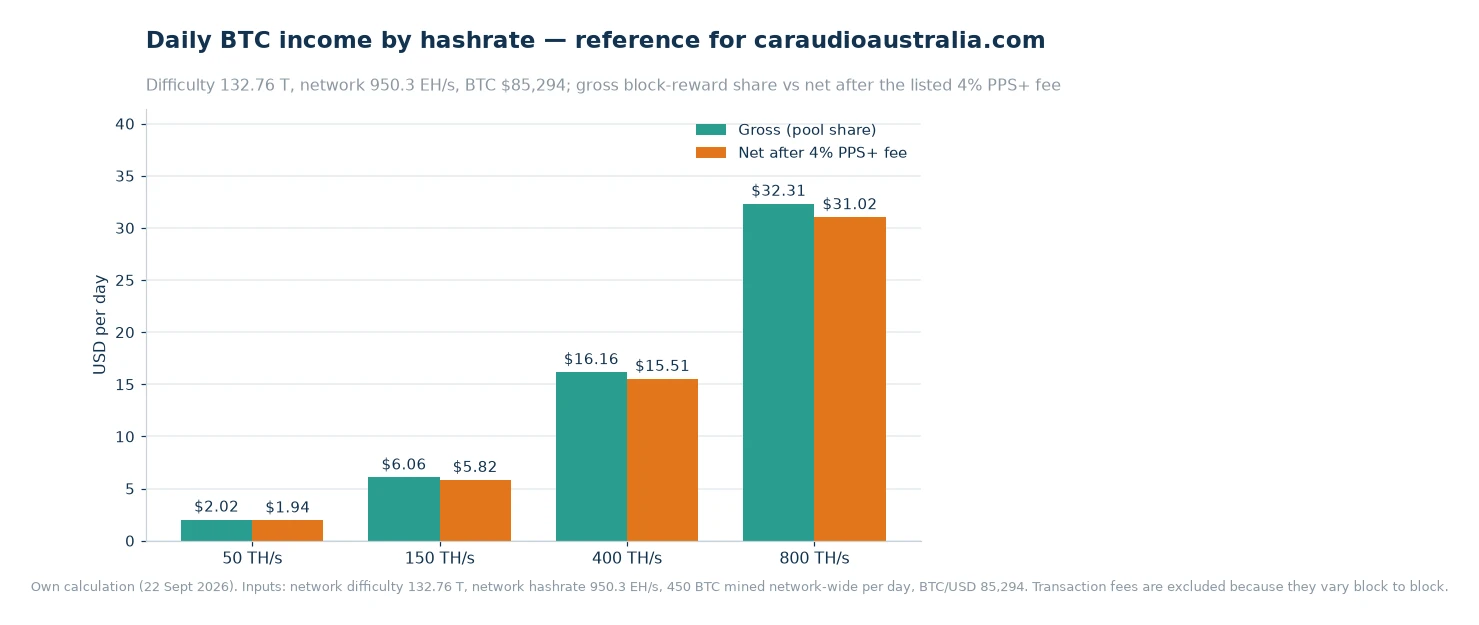
- At 800 TH/s, after the listed 4% block-reward fee, income is about $31.02 a day and $930.60 a month at difficulty 132.76 T and a $85,294 BTC price.
- Uptime is usually the biggest silent error: 95% instead of 100% removes about $46.56 over the month.
- Power at $0.0600/kWh costs $23.04 a day at 800 TH/s and 20 J/TH; at the $0.0808/kWh breakeven it costs more than the income produces.
- Difficulty and price are both moving: an estimated +1.90% adjustment and each 10% of price change move a month by about $17.40 and $93.12.
Every estimate starts with a default
A projection begins with inputs someone else chose. Hashrate you supply yourself, and the network figures come from public chain data, but the softer inputs — uptime, power price, whether difficulty holds still — are usually inherited defaults that nobody edits. At difficulty 132.76 T and an implied network hashrate of 950.3 EH/s, one TH/s earns about 0.0000004735 BTC a day, or $0.0404 at $85,294 per BTC, and $0.0388 after the listed 4% applies to the block-reward component.
Scale that to 800 TH/s and the machinery is clear: $32.31 a day gross, $31.02 after the listed fee, and about $930.60 across 30 days. Everything in the next table is a variation on that figure, which is why the audit is worth doing before the purchase rather than after the first power invoice.
The assumptions worth auditing
| Assumption | Default in a first pass | Realistic variant | Effect on the month |
|---|---|---|---|
| Uptime | 100% of 720 hours | 95% of 720 hours | Income falls to $884.07, about $46.56 less |
| Difficulty | 132.76 T, unchanged | Next adjustment estimated +1.90% | About $30.44 a day, roughly $17.40 less over 30 days |
| BTC price | $85,294 | Any 10% move either way | About $93.12 a month per 10% |
| Power price | $0.0600/kWh | $0.0808/kWh, the 20 J/TH breakeven after the listed 4% | Power rises from $691.20 to about $930.82 a month |
| Fee basis | Listed 4% on the block reward | Listed 2% on both components under PPLNS | About $1.29 a day already deducted under PPS+ |
Notice that the power row and the income row meet at almost the same number. That is not a coincidence: $0.0808/kWh is the breakeven price for a 20 J/TH machine after the listed 4% fee, so an estimate using that power price should produce a margin near zero regardless of how much hashrate it assumes.
Worked example
Take one 800 TH/s fleet at 20 J/TH on a $0.06/kWh supply. Draw is 800 × 0.02 kW = 16 kW, so 384 kWh a day. At $0.06/kWh the power bill is $23.04 a day, or $691.20 across 30 days.
Income after the listed 4% is $31.02 a day, or $930.60 a month. Subtract power and the margin is $8.00 a day, about $239.40 for the month. Now degrade the two softest inputs. At 95% uptime income drops to $884.07 while power falls to $656.64, so the margin becomes $227.43, and the missing hours cost about $11.97 of it.
Change the power price instead, to $0.0808/kWh: the bill rises to $930.82 a month against the same $930.60 of income, and the margin is gone. Move difficulty by the estimated +1.90% and income falls to about $913.20, another $17.40 removed. Three small assumption changes take a fleet from comfortably positive to effectively unprofitable without a single hardware change. The same reasoning repeats in miniature on one 50 TH/s unit: after-fee income is $1.94 a day, power at 20 J/TH costs $1.44, and the untested margin is $0.50. Small fleets have less room to absorb a bad input, not more.
Auditing the numbers in one tool
The point of an audit is consistency: the same difficulty, the same price and the same listed fee basis across every scenario. The ViaBTC Mining Calculator takes price, difficulty, listed fee and effective hashrate together, which makes it easy to change one input at a time and watch the result move. Reading it as a Profit Calculator rather than a single answer is how you find out which assumption a project really depends on, because changing one input at a time is faster and less error-prone than rebuilding a spreadsheet for every scenario.
Two references make the audit quicker. The pool statistics page gives the difficulty and network hashrate to use as a base case, and the Miner Profitability Ranking shows what current hardware earns at the present network, which is a useful sanity check when an estimate promises more than the machines on that list deliver.
Where the hidden errors live
Two more assumptions rarely appear in a table at all. The first is that PPS+ and PPLNS produce the same number. They do not: PPS+ pays a listed 4% on the PPS-settled block reward and a listed 2% on transaction fees, while PPLNS applies a listed 2% to both components together, so a fee sensitivity should be run on the basis you actually chose.
The second is that payouts arrive on schedule. PPS+ settles hourly at current difficulty, while PPLNS pays after six confirmations and shares the block reward across the last five difficulty rounds, which means a single week can land well above or below the average. An estimate is a long-run shape, not a forecast of any particular week, and the variance is a feature of the method rather than an error in the arithmetic.
Hardware assumptions decay too. A machine rated at 20 J/TH when new can drift upward as power supplies age, filters clog and summer ambient temperatures rise, and that drift lands on the power line without any visible change in hashrate. An audit that still uses the datasheet figure in year three is measuring a different machine from the one on the floor.
Frequently asked questions
Which assumption should be checked first?
Power price, then uptime. At 800 TH/s and 20 J/TH the power bill is $23.04 a day against $31.02 of after-fee income, so a move from $0.06 to $0.0808/kWh removes the entire margin, while five points of uptime costs about $46.56 a month.
Why does the estimate change when I switch payout method?
Because each rate acts on a different slice of the payout. Under PPS+ the PPS-settled block reward is charged at a listed 4% while the transaction-fee component sits at a listed 2%; PPLNS applies one listed 2% rate to the two combined. The same hashrate therefore produces two different net figures.
Is the excluded transaction-fee income a problem?
It is a deliberate omission. Transaction fees vary block to block, so a stable estimate usually models the block-reward component only, which is also why a real month can come in slightly above the projection.
Stress the inputs before the hardware
Run each assumption to its uncomfortable value and see which one breaks the project. If a 5% uptime gap or a single difficulty adjustment turns a plan negative, the plan was relying on perfect conditions rather than on margin. Keep the base case, the stressed case and the dated network figures in one note, and re-run them when difficulty moves. That habit costs an hour and it is the difference between a projection and a wish. Write the stressed case in the same note as the base case, and decide in advance which input would make you switch a fleet off rather than keep paying for hashrate that does not cover its own bill.
Data points and sources: ViaBTC's listed fee schedule[1], pool statistics[2] and the miner profitability reference[3]. Network difficulty 132.76 T, implied network hashrate 950.3 EH/s, the 3.125 BTC subsidy that produces 450 BTC a day network-wide and the $85,294 BTC price were read 22 Sept 2026. Each figure was derived by hand from the inputs listed above, so treat it as a worked example: a change in difficulty, price or power cost rewrites the answer, and this page makes no commitment about future income.